

Somalia’s economy is undergoing one of the most unconventional transformations in Africa. Three decades after state collapse, the country is steadily repositioning itself as a frontier market shaped by trade, entrepreneurship, digital innovation, and strategic geography. While insecurity and institutional fragility continue to constrain growth, a new wave of reforms, infrastructure investments, and regional integration efforts is beginning to reshape the country’s economic trajectory. Across Mogadishu, cranes, high-rise developments, new roads, port expansions, and digital payment systems are redefining the image of a country long associated primarily with conflict. From bustling markets and telecom hubs to new logistics corridors and energy projects, Somalia is quietly building the foundations of a modern economy driven by private enterprise, diaspora investment, and technological adaptation.
The macroeconomic outlook reflects cautious optimism. Somalia reached the Heavily Indebted Poor Countries (HIPC) Completion Point in 2023, reducing external debt by approximately $4.5 billion and reopening access to international financing and development support. According to the 2025 Investment Climate Statement, Somalia’s GDP grew by an estimated 4.2 percent in 2023 and 4 percent in 2024. The Federal Government has accelerated reforms under the National Transformation Plan (NTP 2025–2029), focusing on investment climate improvement, customs modernization, digital governance, and private-sector-led growth. These reforms are increasingly linked to Somalia’s long-term Vision 2060 agenda, which seeks to transform the country into a peaceful, connected, climate-resilient, and middle-income economy by the centenary of independence.
Somalia’s policy environment is also gradually evolving from fragmented informal arrangements toward a more structured regulatory system. The launch of the Somali Business Registration System introduced a digital one-stop platform designed to simplify company registration and licensing processes while reducing corruption risks. Meanwhile, new investment laws now provide guarantees for investor protection, profit repatriation, and equal treatment for foreign firms.
Yet Somalia’s economic transition is unfolding at a time when the global development finance system itself is entering a period of uncertainty. For decades, Official Development Assistance (ODA) has played a central role in financing Somalia’s humanitarian response, institution-building, infrastructure recovery, and stabilization efforts. However, global aid flows are now declining sharply, creating growing pressure on fragile and aid-dependent economies such as Somalia. At the same time, Somalia is attempting to build a more self-sustaining economic model anchored in domestic revenue mobilization, trade expansion, investment attraction, and private-sector growth. Recent OECD data illustrates both the progress made and the scale of the challenge ahead.
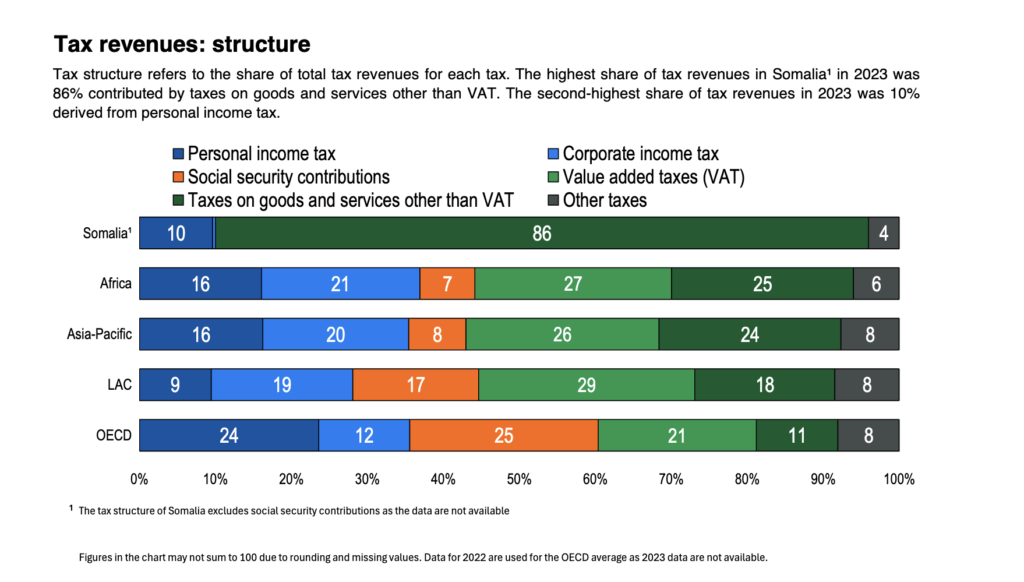
According to the OECD’s Revenue Statistics in Africa 2025: Somalia, Somalia’s tax-to-GDP ratio increased from 1.0 percent in 2013 to 2.9 percent in 2023, the highest level recorded in the past decade. While still among the lowest in Africa, the increase reflects gradual improvements in customs modernization, tax administration, and domestic revenue collection. However, Somalia’s tax base remains extremely narrow compared to continental averages. In 2023, Somalia’s tax-to-GDP ratio stood at just 2.9 percent, compared to the African average of 16.1 percent. OECD data further shows that 86 percent of Somalia’s tax revenues came from taxes on goods and services other than VAT, while personal income tax contributed only 10 percent. This reflects the country’s heavy dependence on trade-related taxation and import-based revenues.
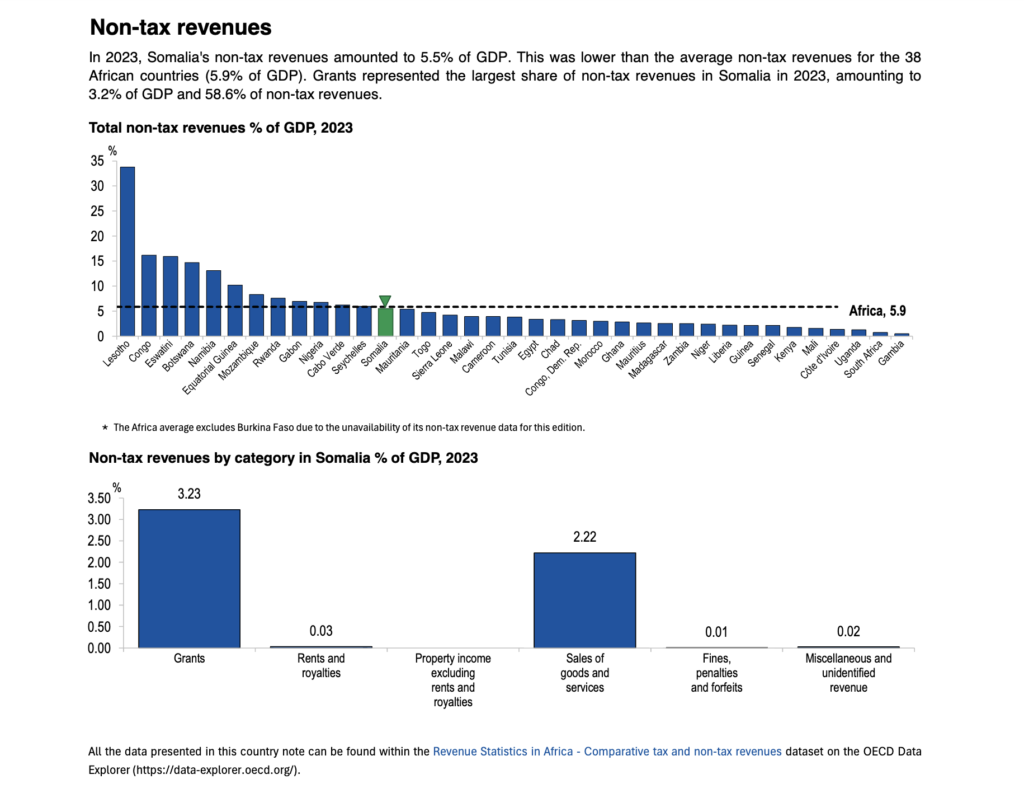
Non-tax revenues remain equally important. In 2023, Somalia’s non-tax revenues amounted to 5.5 percent of GDP, with grants accounting for 3.2 percent of GDP and nearly 59 percent of total non-tax revenues. The figures underscore both the continued importance of external financing and the urgency of expanding domestic productive sectors. Trade and logistics remain central to Somalia’s economic identity. Its strategic coastline along the Indian Ocean and Gulf of Aden places the country near some of the world’s busiest maritime routes. Ports such as Mogadishu, Berbera, Bosaso, Kismayo, and Garacad are increasingly becoming regional commercial gateways linking the Horn of Africa with Gulf and Asian markets.
Regional integration is also reshaping Somalia’s economic future. The country formally joined the East African Community in 2024, opening new opportunities for trade, mobility, and market integration across East Africa. Somalia is simultaneously advancing engagement with the African Continental Free Trade Area while reactivating its accession process to the World Trade Organization. Mogadishu itself is undergoing rapid urban transformation. New city expansion plans, real estate investments, road construction, and port modernization projects are gradually shaping the vision of a “New Mogadishu”, a capital aspiring to become a regional commercial and logistics hub.
Perhaps Somalia’s most remarkable achievement lies in the digital economy. In the absence of a strong conventional banking system, Somali entrepreneurs built one of Africa’s most advanced mobile money ecosystems. Much of daily commerce today operates digitally through telecom-powered payment systems denominated largely in U.S. dollars. This digital transformation is gaining global recognition. A recent report by the International Telecommunication Union ranked Somalia first in Africa in mobile money and digital financial inclusion indicators, underscoring the country’s remarkable leapfrogging in fintech and telecommunications despite decades of institutional fragility.
Diaspora investment remains one of the economy’s strongest stabilizing forces. Annual remittance inflows are estimated at approximately $2 billion, equivalent to nearly 25 percent of GDP. These flows continue to sustain household consumption, entrepreneurship, education, real estate, and small business investment across the country. At the same time, Somalia is positioning itself around future-oriented sectors such as renewable energy, fisheries, blue economy development, climate-smart agriculture, and logistics. Offshore energy exploration projects, including the Curad-1 drilling initiative, have further elevated investor interest in Somalia’s untapped hydrocarbon potential and strategic energy position in the Horn of Africa.
Still, serious structural constraints remain. Insecurity, weak institutions, fragmented regulation, corruption, infrastructure deficits, and climate vulnerability continue to raise the cost of doing business. The 2025 Investment Climate Statement identifies insecurity, unreliable electricity, weak judicial systems, and corruption among the top barriers to investment. Yet Somalia’s economy is no longer defined solely by fragility. It is increasingly defined by adaptation, entrepreneurship, digital innovation, and regional integration. The private sector has often moved faster than formal institutions, building systems of finance, trade, telecommunications, and logistics under extremely difficult conditions.
The next decade will determine whether Somalia can successfully convert this entrepreneurial momentum into broad-based and institutionalized economic transformation. If reforms continue, infrastructure expands, governance strengthens, and Vision 2060 remains anchored in productive economic growth, Somalia may emerge not merely as a recovery story, but as one of Africa’s most strategically significant frontier economies.
Written by Mohamed Okash, Editor-In-chief, Somali Business Review